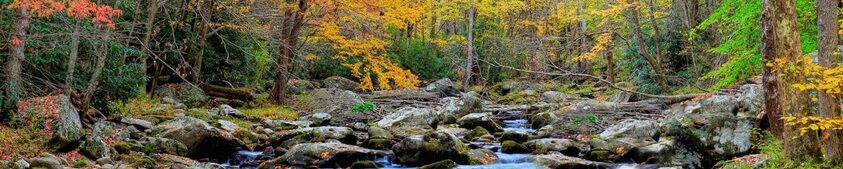
Great Smoky Mountains Fall Foliage
The annual Great Smoky Mountains fall foliage show starts each year in late September. The colors of fall foliage continue to spread across the Great Smoky Mountains well into early November. While traveling in the Great Smoky Mountains in the autumn, there will always be somewhere to view peak color. This is because of the different elevations located within the park. This area is fortunate to have about 6-8 weeks in the autumn to undergo this show of nature as the warm days of summer transition into the cold days of winter. Each year, the mountains put on a beautiful show of fall foliage. With all the different elevations in the various mountain regions of North Carolina and Tennessee, there are a lot of areas to travel to in October to view the beautiful autumn colors.
Some popular spots to view the fall foliage show in the Great Smoky Mountains are:
Cades Cove
Tremont
Foothills Parkway
Cataloochee Valley (elevation of 2680 ft)
Mt. LeConte (elevation of 6,593 feet and the third highest summit in the Great Smoky Mountains National Park)
Greenbrier
Alum Cave Bluffs
Chimney Tops
Andrews Bald (elevation of 5920 feet)
Clingmans Dome (elevation of 6,643 feet and the highest point in the Great Smoky Mountains National Park)
Newfound Gap Road (elevation of 5,048 feet)
Blue Ridge Parkway


Here is a link to Great Smoky Mountains Guide webcams.
Webcams are a great way to check
the fall foliage progress!
A General Guide to the Fall Foliage Season for the Great Smoky Mountains
When and Where
October 4-10
The highest elevations 5,000 to 6,000 feet and above in the Great Smoky Mountains, will start to show color first. North of Asheville in North Carolina in the highest elevations above 5,000 feet is where the fall foliage show begins and is where the most color typically occurs. These areas include Kuwohi, Mt. LeConte, Newfound Gap, Andrews Bald, Balsam Mountain, Mount Mitchell, Beech Mountain, Craggy Gardens, Grandfather Mountain and Rough Ridge.
October 8-18
Fall foliage color will then start to appear in elevations that are 4,000 to 5000 feet. Areas including the Mount Pisgah, Black Balsam, Devil’s Courthouse, Waterrock Knob and Graveyard Field. Peak color also occurs in this time period for the Highlands area, including Whiteside Mountain and the Great Smoky Mountains National Park. Try Alum Cave Bluffs, Chimney Tops or Ramsey Cascades to see colors during these weeks.
October 15-24
In the surrounding mountains of Asheville there is plenty of color in the 3,000-4,000 foot elevation range. A ride north or south on the Blue Ridge Parkway from Asheville will be a beautiful site about this week. A ride through the Pisgah National Forest (Looking Glass Rock or Cradle of Forestry) normally is a great trip. North of Asheville Linville Gorge (Table Rock and Hawksbill Mountain) would be a nice fall foliage hiking trip. Also, Boone, Blowing Rock, Stone Mountain Park, Cashiers and Hanging Rock.
October 20-30
In the GSM color will be good at Cataloochee Valley and Oconaluftee. Elevations of 2000 to 3000 feet are showing color by now. The city of Asheville at the 2,000 feet elevation has the peak colors during this time period, as well as areas around Hendersonville and Brevard. DuPont State Forest or the NC Arboretum are great places to enjoy the fall foliage colors. The Biltmore Estate in Asheville is also at peak leaf color during the latter part of October.
October 24-November 5
The color show nears its end in the Chimney Rock area with an elevation of 1,300 feet although Chimney Rock summit is at 2880 feet.. Visit Chimney Rock and Lake Lure for a last look at the beautiful fall foliage season in the North Carolina mountains. In the Great Smoky Mountains head to Cades Cove and Cherokee.


Fall Foliage and Elevations In The Great Smoky Mountains
Peak colors appear first in the highest elevations (over 5500ft) and work down to the lower elevations. Color changes usually start in late September in the highest elevations and continue to spread color down into the lower elevations of the Great Smoky Mountains into early November. Peak color will be at different times depending on the weather and elevation.

Great Smoky Mountains Fall Foliage 2022
With all the different elevations in the Great Smoky Mountains, there will always be a colorful view somewhere during October and even into November. Enjoy the nearby towns too. Visit Gatlinburg and Pigeon Forge in TN; Cherokee and Bryson City in NC, just to name a few!

GSM Fall Color Reports and Weekly Updates for 2022
Fall Foliage In The Great Smoky Mountains

Great Smoky Mountains Fall Foliage 2022
Weather is Key To Peak Color Timing
The key to the start of fall foliage color changes depends on the weather. The most important ingredient for fall foliage is cool air. Cool air is needed to promote the formation of colorful pigments. Also important is enough rain in the weeks and months before fall. A dry summer is not good. Next needed is a dry, cool, and sunny autumn (warm days and frostless nights). Frost will kill the leaves and make them die and fall off early.
Fall foliage starts in the highest elevations first and then progresses down to the lower elevations as October progresses. So peak color times happen in the highest elevations (over 5500ft) and work down to the lower elevations. Color changes can start in late September and continue into early November, depending on the elevation and the weather.
GSMNP Elevations
The highest elevations above 5000 feet peak first about the first week of October. These areas include Kuwohi, Mount LeConte, Newfound Gap, Andrews Bald, Alum Cave Bluffs, Chimney Tops, Ramsey Cascades and Balsam Mountain.
Elevations in the 4000-3000 ft range peak about the second week of October.
Elevations in the 3000-2000 ft range peak about mid to late October or even early November. These areas are Cataloochee Valley and Oconaluftee.
Elevations at 2000ft and lower peak about the third week in October.
Cades Cove has an elevation of 1716 ft and will be one of the last areas to show color and peak. The lower elevations of the GSM peak in late October or early November.
Fall in Cades Cove
But the Great Smoky Mountains National Park covers such a large area of land that there is always somewhere at peak or near peak. The GSMNP mountain ranges have elevations from just over 875 feet to 6,643 feet. So a trip to view the fall color show anytime in October will reward you with a spectacular show of color.
The Great Smoky Mountains and when the fall colors appear

Great Smoky Mountains Fall Foliage
The changes start at the higher elevations (above 5,000 ft.) about the first of October and will work its way down to the lower elevations in late October to early November. The best places to see color are Newfound Gap Road, Cades Cove Loop Road and Little River Road. Great hikes to see the show are Albright Grove and Sugarland Mountain Trail and Andrews Bald or Mt. LeConte at the highest elevations.
Due to the varied elevations of the Great Smoky Mountains, you can always find the best show of color somewhere in the fall months starting in late September, October and lasting through November. The biggest factors involved in the changing colors of the foliage are elevation and weather. The warmer the weather the slower the progression but colder temperatures will speed up the fall foliage show.
The typical best times to plan a trip to view Tennessee’s peak fall foliage would be:
● Northeastern Mountain Regions – First of October to mid-October
● Color Across Middle and Western Tennessee – Peaks from East to West Mid Mid-October to Late November
The typical best times to plan a trip to view the Great Smoky Mountains and North Carolina Mountains peak fall foliage would be:
● Western North Carolina Highest Elevations (above 5,000 ft) – Grandfather Mountain, Graveyard Fields, Mount Mitchell. Great Smoky Mountains National Park- Kuwohi, Mount LeConte, Andrews Bald. – Late September to First Week of October.
● Western North Carolina Elevations (4,000- 5,000 ft) Mount Pisgah, Devil’s Courthouse, North of Asheville and South of Asheville in Boone, Blowing Rock, Highlands, Mt. Jefferson. Great Smoky Mountains-Newfound Gap, Alum Cave Bluffs, Chimney Tops. About the Second Week of October.
● Western North Carolina ( 3,000-4,000 ft) – Asheville area North and South. Craggy Gardens, Beech Mountain, Boone, Blowing Rock. In the GSM go to Ramsey Cascades, Cataloochee Valley, and Gatlinburg. About the 2nd or 3rd week of October
● Western to Central North Carolina (2,000- 3,000 ft) – The city of Asheville, Biltmore Estate, Sylva, DuPont State Forest. In the GSM visit Oconaluftee, Cherokee, Cades Cove, and Townsend. Mid-October to late October
● Central North Carolina (1,000-2,000 ft)- Chimney Rock, Lake Lure, South Mountain State Park in late October to Early November
Here is a Map Showing Typical Fall Foliage Peak Colors Time Table in the Great Smoky Mountains

GSM Fall Foliage Map (from Visit My Smokies)
Here is a Map of North Carolina Showing Typical Fall Foliage Peak Colors Time Table

NC Fall Foliage Map (Conceived by Howard Neufeld and Michael Denslow,
Map Constructed by Michael Denslow)
Type of Tree Depends on Color Display!
The type of tree determines the color the leaves will turn during the fall foliage season. It is not just a random process. Different types of trees will turn a specific shade during autumn. All the different varieties of trees in the Great Smoky Mountains make all the different colors on display during the fall foliage season.
The leaves of these trees will turn a yellow or golden color:
Tulip Poplar, Birch, Black Cherry
The leaves of these trees will turn a red or maroon shade:
Dogwood, Sourwood, Shining Sumac
The leaves of these trees will turn an orange, brown or russet shade:
Hickory and Oak Trees
Different types of Maple trees have their own fall foliage shade:
Sugar Maple leaves turn an orange-red shade.
Black Maple leaves turn a glowing yellow shade.
Red Maple leaves turn a bright scarlet or orange shade.
Fall Foliage Coloration Guide Showing What Colors Develop From Different Trees

Fall Foliage Coloration Guide (image by WV Division of Forestry)
Links to Web Cams showing fall foliage:
Purchase Knob Webcam Link live view and Look Rock Webcam Link live view.
Enjoy!
More Resources For Fall Foliage Reports
Travel Blue Ridge Parkway – specific to the Blue Ridge Parkway in Virginia and North Carolina as well as Skyline Drive in Virginia, Shenandoah National Park and the Great Smoky Mountains National Park
North Carolina Travel – fall foliage reports and updates specific to the North Carolina mountains including Asheville, Boone, Blowing Rock, Grandfather Mountain, Cashiers and Highlands and Chimney Rock
Photos from past fall foliage seasons in the Great Smoky Mountains.


